

Why the difference between sensory modulation and sensory discrimination changes how we understand, and support, a child.
You’re at the front door with a bag of shopping on one arm and it’s dark. You reach into your bag and, without looking, you find your keys. Then, still without looking, you find the right one: the shape of the head, the extra weight, the way it’s bigger than the others on the set. It’s in the lock before you’ve thought about it.
That’s sensory discrimination, and it’s something I’ve been thinking about a lot lately, mostly because of how often it gets confused with its partner, sensory modulation.
Sensory modulation and sensory discrimination sound similar, and both are foundations of sensory processing – but they really are two different things. Knowing the difference changes how we understand a child with sensory processing differences, and more importantly, it changes how we support them.
If you’ve read the Dunn series on this blog, you already know a fair bit about sensory modulation. Discrimination is the part that series doesn’t cover. Dunn’s Sensory Profile is organised around modulation. The quadrant scores tell you about thresholds and behavioural responses – how much input a child needs and how they tend to respond to it.
There’s no “discrimination score”, because that isn’t what the framework was designed to produce. But the items are a different story, and this is where I think a lot of useful information gets left on the table.
A child who bumps into furniture and people scores toward low registration: a high threshold, not noticing. But bumping also happens when a child doesn’t have a clear sense of where their body ends. A child who presses very hard with their pencil might be seeking pressure, or might not be able to feel how hard is hard enough. Same tick on the form. Two different children. The score can’t tell them apart.
If we read a modulation score and stop, we go looking for modulation strategies (movement breaks, fidgets, headphones, a quiet corner) and we might miss what the child is really struggling with…
Modulation asks how much. Discrimination asks what.
Sensory modulation
Sensory modulation is how our brains register sensory input and then respond to it. The easiest way to see it is to picture a child trying to listen to their teacher.
First, how much input can their brain take? This is where my cup analogy from the Dunn series fits. A child with a small cup, or a low threshold, fills up fast. The loud class discussion or the itchy tag in their shirt is enough to overflow it. A sensory seeker has a big cup. Their brain needs lots of input, often movement, before it registers what’s happening, feels contained and can pay attention. Most children are a blend of patterns, and the same child can shift from one day to the next depending on how tired, hungry or stretched they are.
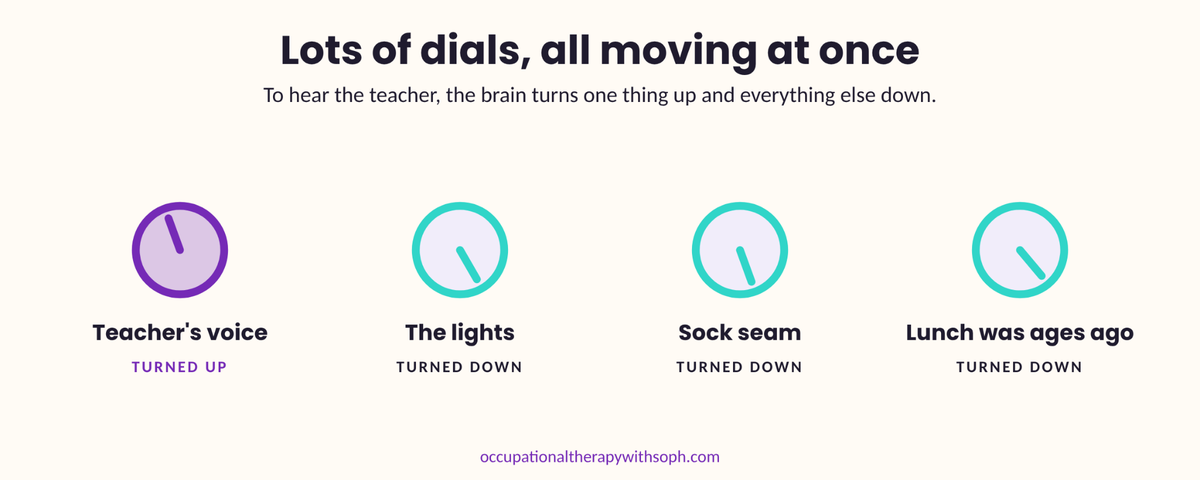
Second, what gets turned up and what gets turned down? To hear the teacher, the child’s brain isn’t just letting her voice in. It’s also turning down the hum of the lights, the itch of a sock seam and the fact that lunch was a long time ago. Dr A. Jean Ayres, the OT who developed sensory integration theory, described modulation as exactly this: turning up some messages and turning down others. Tracy Stackhouse, a paediatric OT and one of the hosts of the Spirited Conversations podcast, describes the brain not as one dial but as lots of dials, all moving at once.
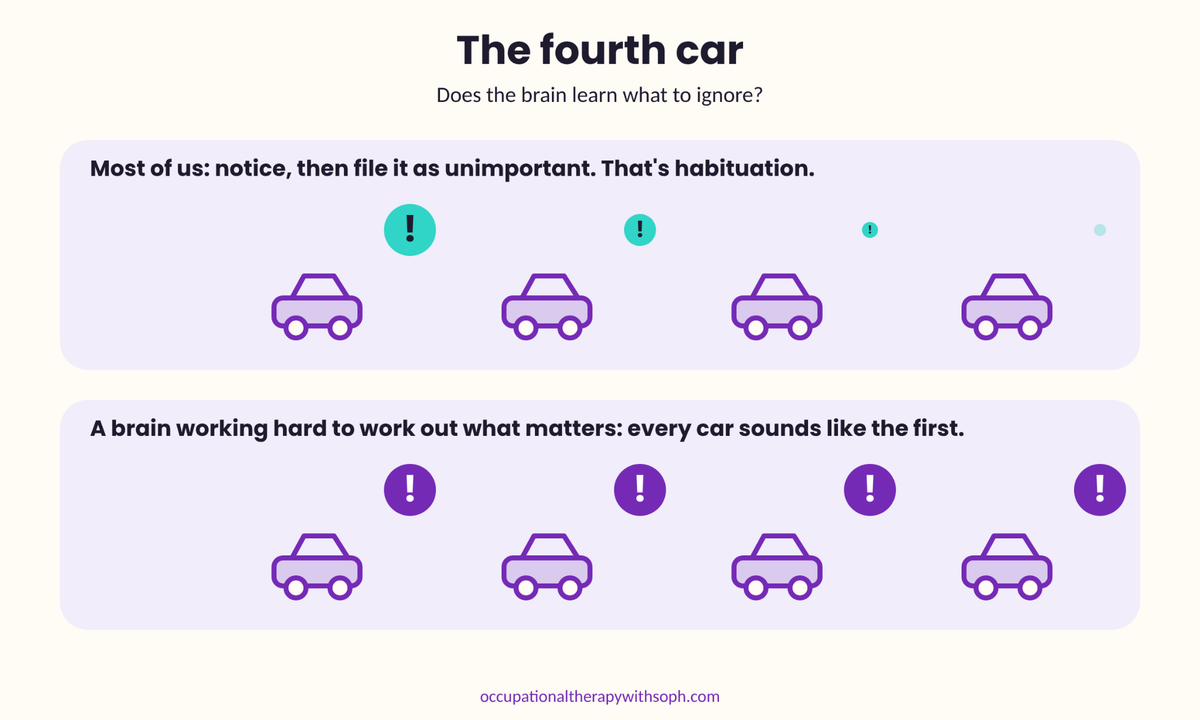
Third, does the brain learn what to ignore? A car goes past the window. The first time, most of us notice. By the fourth time, we’ve quietly filed it under “not important” and stopped responding. That’s habituation, and it’s the same reason you stop hearing the fridge. For a child whose brain is working hard to work out what matters, that filing doesn’t happen. They can’t turn the car down to tune the teacher in. The fourth car may sound like the first, every time.
Sensory discrimination
Sensory discrimination is how our sensory systems notice the details: the qualities of what we’re sensing. Not how much, but what. The shape of a football in your hands (touch). The smell of freshly cut grass (smell). The heaviness of a full backpack (proprioception). The difference between a b and a d (sight). The difference between two notes on a piano (hearing). Knowing whether you’re speeding up or slowing down on the roundabout (vestibular). And working out whether that funny feeling in your tummy is hunger or nerves (interoception).
We need all this detail to get things done. Think about cracking an egg. Tap too gently and nothing happens. Hit too hard and there’s shell in the bowl. You feel how much force it took, you see the result, and next time you adjust. Most of us got the hang of it after a few messy attempts.
This is also called praxis: planning and carrying out what we want our bodies to do. Ayres saw sensory discrimination as its foundation, because the clearer the sensory detail coming in, the better the plan going out.
What happens when the detail isn’t clear?
Think of the child who hugs very firmly, high-fives too hard and tags too hard in the playground. Their body might not be giving them clear enough detail (sensory discrimination) about how much force they’re using, so they can’t feel the difference between a squeeze and a crush. Other children complain. The child gets told off, and genuinely doesn’t know what they did wrong.
From the outside, that looks like a sensory modulation problem. A sensory seeker with a big cup, chasing deep pressure to settle themselves, and going about it in ways that don’t work for anyone else. So we build in heavy work and movement breaks to meet the need. That support matters, and for some children it’s exactly right. But on its own it can miss the point. This child doesn’t need more input. They need clearer information about the input they’re already getting. They need the detail.
Here’s what each one tends to look like across a school day.
| Discrimination: the detail | Modulation: the amount | |
|---|---|---|
| In the classroom | Pencil pressure – faint, unsteady, or too heavy. | Covering their ears at assembly. |
| Tipping the whole pencil case out rather than feeling around for the rubber. | Can’t settle at mat time: rocking, fidgeting with everything in reach, always on the move. | |
| Mixing up b and d past the age it usually settles, or mishearing instructions when two words sound alike. | Not responding to their name in a busy room. | |
| Getting dressed | Buttons, zips and shoelaces staying hard long after friends have got them. | Can’t stand tags, seams or socks that “feel wrong”. |
| After school | Exhausted after a day of tasks that take more effort than they should. | Holding it together all day, then falling apart the moment they get in the car. |
Some behaviours could sit in either column. Hugs that are too hard, bumping into people and heavy pencil pressure can come from seeking (modulation) or from not being able to feel how hard is hard enough (discrimination). That’s why it’s important to think curiously about what we are seeing.
So far, this reads as a clean split between modulation and discrimination. In practice, the two inform each other.
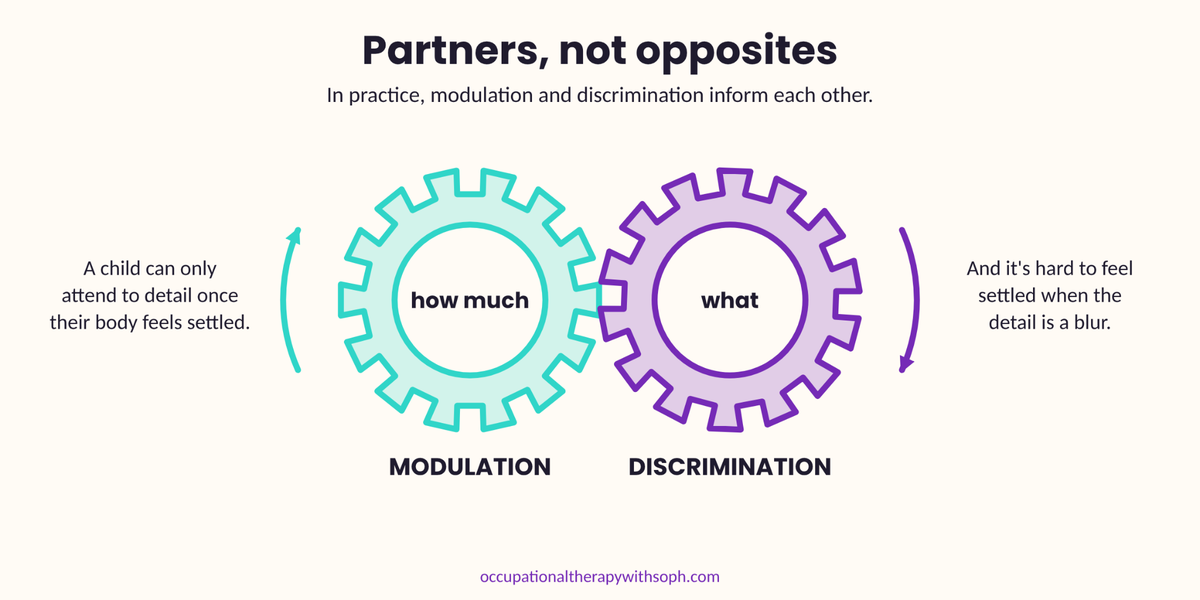
A child can only attend to detail once their body feels safe. When the system is on alert, it fixes on the thing it’s alerting to. A child who can feel every thread of a scratchy tag has nothing left over for where the armhole is. And if you’re working hard just to hold yourself up against gravity, the fine detail of where the lace goes isn’t going to get a look in. Modulation difficulties, postural difficulties and anxiety all narrow what a child can attend to.
It works the other way too. If your body can’t feel detail clearly, it’s very hard to feel safe. A child who can’t read their own body has less to feel secure in. Each one makes the other harder.
Which turns the question from which one is it into where do I start. Tracy Stackhouse describes modulation and discrimination as partners, and I loved her explanation of this on a recent episode of Spirited Conversations.
Final thoughts…
Whether you’re a therapist, a teacher or a parent, you’ll have met children on both sides of this line, and plenty who sit right on it. The point isn’t to sort them into boxes. It’s to look twice before we decide what a behaviour means.
So if you take one thing from this post, make it a question. The next time a child has you thinking about a sensory strategy, pause and ask: how much, or what? Is this a child whose cup is overflowing, or a child whose body isn’t giving them clear enough information to work with? Sometimes it’s both. But “more input” and “clearer input” are not always the same supports, and asking first means we’re more likely to choose the one that helps.
If this has got you thinking about a child you know, I’d love to hear about it. And if you want the modulation half of the picture in more depth, my free guide, The 4 Sensory Patterns, walks through all four sensory patterns.
Questions
If you have any questions or need further assistance please do not hesitate to get in touch here or at hello@otwithsoph.com.


