
A felt-safety approach to toileting strategies for neurodivergent children.
Have you ever walked into a room and felt your shoulders tighten before you even knew why? Maybe the lighting was harsh, or there was a strange smell, or something about the space just felt off. Your body noticed before your brain caught up.
Children experience this too, especially in bathrooms.
Most toileting strategies for neurodivergent children jump straight to the toilet: the sitting, the timing, the reward chart. But for a lot of children, the room itself is the thing the body is reacting to. Before any of the usual strategies have a chance to land, the toilet and the space around it have to feel safe. That is where this starts.
The short version: a child can be fully “toilet trained” and still have accidents, refuse to sit, or hold on. Often it is not a behaviour to fix. Their nervous system does not feel safe enough to let go, or their body signals are quiet, delayed, or hard to read. The first job is felt safety, not compliance.
Why felt safety has to come first
Elimination (weeing and pooing) asks the body to do something quite vulnerable. The pelvic floor muscles need to relax. The sphincters need to soften and open. The nervous system needs to be in a state where it feels safe enough to release, rather than clench and hold.
A child’s body can struggle to do any of that if the environment feels threatening to them, even when it seems perfectly safe to us. And when a child’s nervous system is heightened, stressed, anxious, or overwhelmed, their ability to read body signals accurately can be disrupted. Interoception can be harder to access when the body is in protection mode.
I can remember this happening in my own body. I was about 9, on a family trip through the Bali countryside, absolutely desperate for a poo. We finally found a restroom and I rushed in, only to find a squat toilet, something I had never seen before and had no idea how to use. In that moment of confusion and unfamiliarity, the urge just… disappeared. Completely. My body signals switched off. I did not decide to stop needing to go, it was not a cognitive decision. My body decided for me, because the environment did not feel safe or predictable enough to let go.
Making the space feel neutral, predictable, even comfortable helps build a strong foundation. It is not a step you rush through to get to the “real work.” It is the real work.
Why some neurodivergent children don’t notice the signal in time
Noticing when you need the toilet relies on interoception, the sense that lets us read the messages coming from inside the body. For some children, particularly neurodivergent children and those who process sensory information differently, that signal can be quiet, delayed, or easy to miss until it is suddenly urgent. Others notice clearly but find it very hard to stop an activity and switch tasks. And for children who have been holding on for a while, the signal can become genuinely harder to feel. None of these is defiance. They are different versions of the same thing: a body signal that is tricky to notice or act on. I write more about reading those signals across the newsletter and Instagram, and the resources below go deeper.

How should a child sit on the toilet? The 90 / 90 / 90 posture
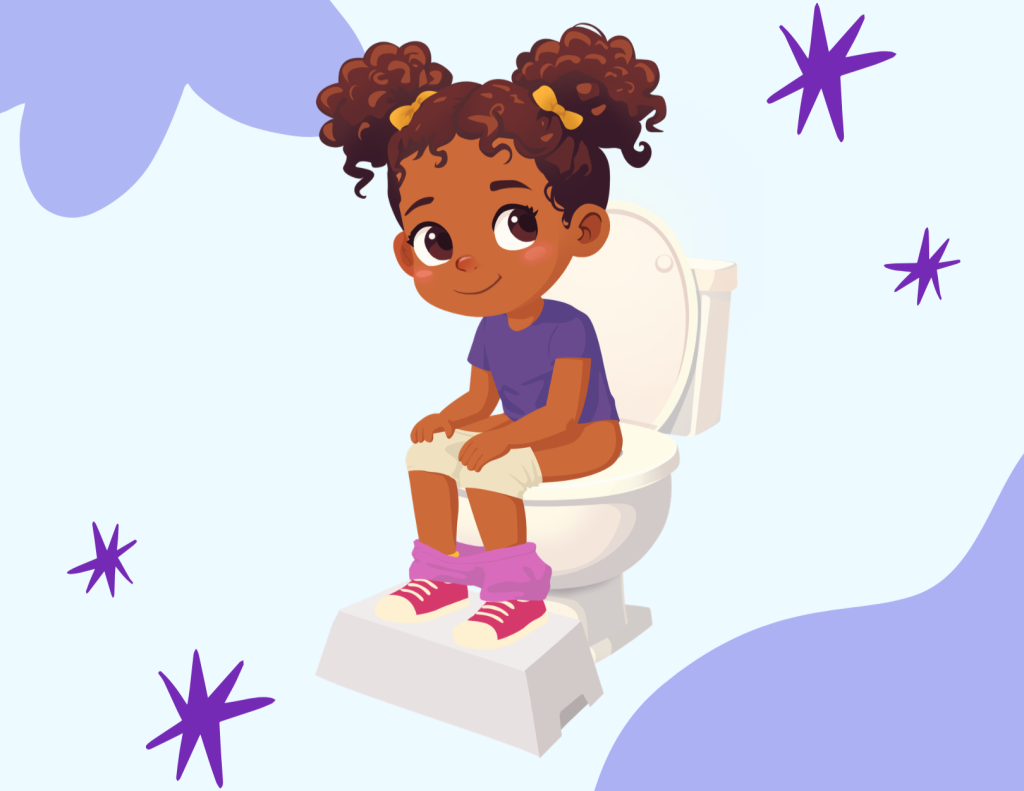
This is the one most people miss, and it is the single most practical change you can make. If a child’s feet are dangling above the floor, their body has no stable base. Their core cannot engage properly, and their pelvic floor cannot coordinate the muscles it needs for elimination.
- Put a step stool under their feet, so the feet are flat and fully supported.
- Aim for knees at or above hip height.
- Encourage a slight forward lean from the hips.
The shorthand is 90 / 90 / 90: roughly 90 degrees at the hips, 90 at the knees, 90 at the ankles. It is a small change that does a lot of the work for them.

How to make the toilet feel safe: practical strategies
Try this: crouch down to your child’s height in the bathroom and pay attention. What do you hear? What do you smell? What does the seat feel like? Where are your feet? You do not need to renovate. Small, inexpensive shifts can change how the room feels to a child’s nervous system.
Sound. Flushing is loud and unpredictable, especially automatic flushes that fire mid-sit. Let the child leave before you flush. In public toilets, a sticky note over the auto-flush sensor stops it firing unexpectedly. Noise-cancelling headphones or ear defenders might help with hand dryers.
Light. Fluorescent tubes flicker at a frequency some children can perceive. At home, swap the overhead for a warm lamp or nightlight. The goal is a space that feels calm, not clinical.
Smell. Chemical cleaning products, air fresheners, and the smells of elimination itself can dominate the experience for a sensitive child. A drop of essential oil on a cotton ball near the toilet can help. Some families carry a small roller in their bag for public toilets. Experiment with your child, when they are regulated, to find which smells they like.
Touch and temperature. A cold seat, scratchy paper, wet surfaces. Each one is a sensory event the body has to process while it is simultaneously trying to relax. A warm wheat bag on the lap can help, and keeping familiar wipes in the bag makes public toilets more predictable.
Comfort and familiarity. A favourite small toy or fidget kept in a bathroom basket. A picture book that lives only in the bathroom. Consider a “toolkit”: a small basket of soft items near the toilet so the child starts to associate the space with relaxation. The bathroom becomes a room they are willing to be in, not a room they are dragged to.
You are part of the environment too
We spend a lot of time thinking about the physical space: the stool, the lighting, the noise. But the most powerful part of a child’s toileting environment is the person in the room with them. Your regulation, your energy, your patience, your body language: these are all signals that your child’s nervous system is reading constantly. A regulated, trusted adult tells a child’s body this is safe. An anxious, frustrated, or rushed adult, no matter how well-intentioned, tells their body the opposite.
This is co-regulation in action. Your child’s nervous system is borrowing from yours. If yours is settled, theirs has a better chance of settling too. That does not mean you need to be perfectly calm (who is, in the middle of a toileting struggle?). It means being aware that your state is part of the equation.
The language you use is part of this too. Phrases like “time to go to the toilet” or “you have to try before we leave” are well-intentioned, but they put the adult in charge of the child’s body. And a child who feels like their body is being controlled by someone else is a child whose nervous system is going to tighten, not soften. Small shifts make a big difference:
- Instead of “Go to the toilet before we leave,” try “Let’s check in with your body. Does anything feel like it might need to come out?”
- Instead of “You need to sit on the toilet now,” try “Your body might have something to tell you. Would you like to sit and see what happens?”
- Instead of “Why didn’t you tell me you needed to go?” try “I wonder if that body signal was tricky to notice. Let’s see if we can spot it together next time.”
- Instead of “Try to do a wee before bed,” try “What does your tummy and bladder area feel like right now? Full, empty, not sure? All of those are okay.”
Important: no forced sits. If a child does not want to sit on the toilet, making them sit will not teach them to use it. It will teach their body that the toilet is a place where their autonomy is taken away. That is the opposite of safety, and it will set the process back, not forward.
When toileting hurts: pain and when to get help
Does it hurt the child to wee or poo? If your child is experiencing pain with toileting, or distress that seems disproportionate to what you can see, this is when it is really helpful to bring in other professionals. Your GP or paediatrician is the starting point.
Once the body feels physically safe, meaning elimination is not painful and any medical contributors have been addressed, that is when the environmental work really starts to land.
You’ve got this
Start with one thing. Maybe it is the step stool. Maybe it is the lighting. Maybe it is just shifting from “time to go” to “I wonder what your body is telling you.”
The bathroom is the foundation. Once it feels safe, the next layer is helping a child notice and make sense of the signals their body is sending, which is its own piece of the puzzle (and one I share more about across the newsletter and Instagram). If you would like a ready-made way to start those conversations, my social skills story Your Amazing Body: It’s Time for a Poo? and its companion guide walk children and the adults around them through exactly that, and the visual toilet routine cards make each step something a child can see.
Questions
If you have any questions or need further assistance please do not hesitate to get in touch here or at hello@otwithsoph.com.
📥 Want more like this?
Grab my free guide — 10 Tips to Build Interoception Skills & Emotional Regulation — and join the list for weekly OT strategies straight to your inbox.

