

Understanding the window of tolerance in children, and why regulated does not mean calm.
You know the child. One minute they’re fine – engaged, laughing, on task. Then something happens. Maybe it’s a loud noise, an unexpected change to the plan, or just the accumulated weight of a long day. And suddenly they’re not fine at all. They’re explosive, or they’ve completely shut down, staring blankly.
There doesn’t seem to be a middle ground. And for a lot of children, there genuinely isn’t – not yet.
This is one of the most common things I see in my clinical work, and it’s often confusing for caregivers. It’s not about attitude, willpower, or how much the child wants to cooperate. It’s about nervous system capacity. Specifically, it’s about something called the window of tolerance.
What is the window of tolerance?
Psychiatrist Dan Siegel coined the term to describe the zone in which our nervous system is functioning at its best — calm enough to think, engaged enough to learn, regulated enough to connect with others.
When we’re inside our window of tolerance, we can process what’s happening around us. We can problem-solve, take in new information, manage frustration, and recover from small upsets. This is the state where learning happens. Where relationships feel safe. Where a child can actually benefit from the strategies we’re trying to teach them.
Outside the window, it’s a different story.
When a child moves into hyperarousal – the upper edge of their window — the nervous system shifts into fight or flight. This is the sympathetic nervous system doing its job, flooding the body with stress hormones to prepare for a threat. In children, this often looks like aggression, explosive outbursts, intense emotional reactions, or frantic, dysregulated energy. The rational thinking brain has effectively gone offline. They are not choosing this. (I’ve written in more depth about what’s happening in the brain and body during these moments in my deep-dive on meltdowns and shutdowns.)
At the other end is hypoarousal – the lower edge, where the nervous system has tipped into shutdown. Stephen Porges’ polyvagal theory offers a clinically useful framework for understanding this state, describing it as a dorsal vagal response: the body conserving energy, withdrawing, going still. In children, it can look like zoning out, refusing to engage, becoming flat or unresponsive, or what adults often call “shutting down.” It’s a protective response.
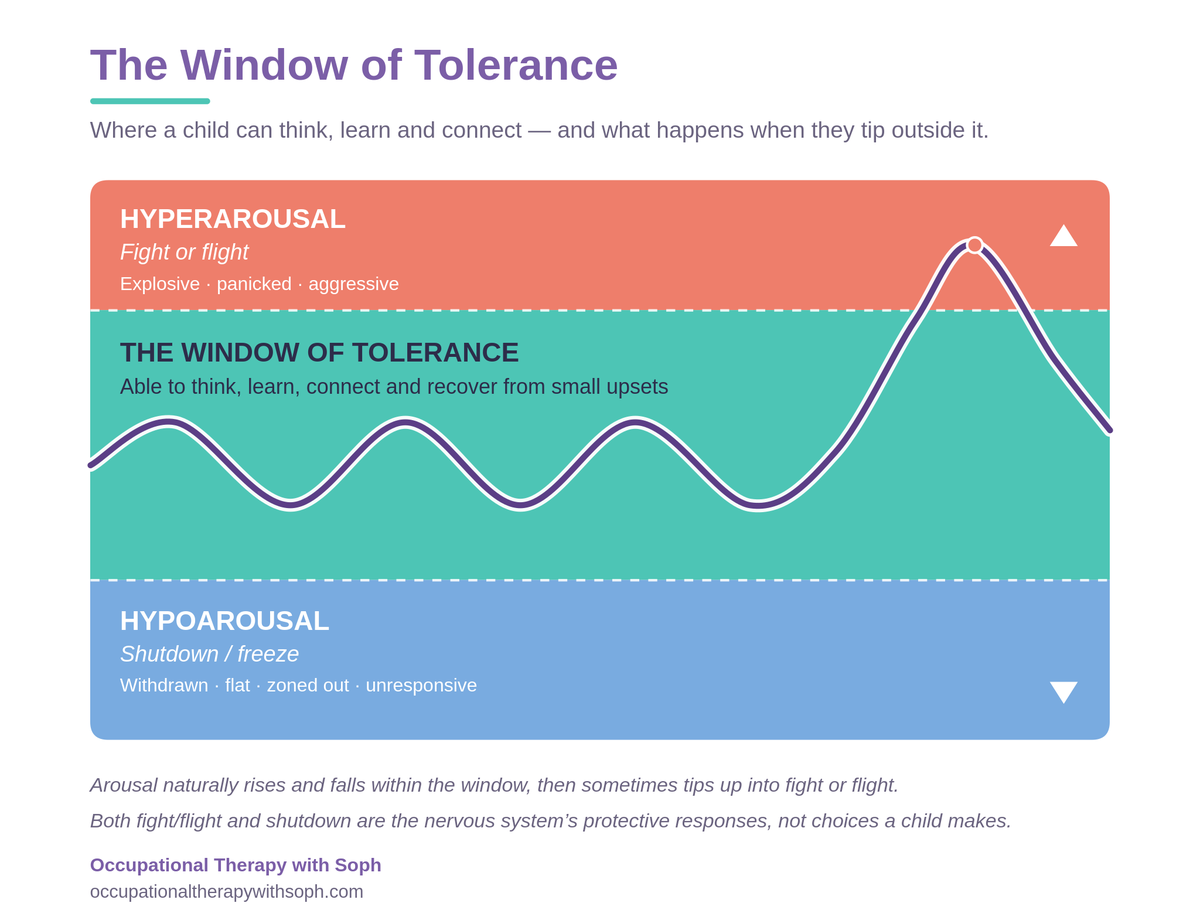
The window of tolerance: the zone where a child can think, learn and connect, and what happens when they tip above or below it.
Why some children have narrower windows
Not all children have the same window of tolerance and this matters enormously when we’re trying to understand their behaviour.
For children with sensory processing differences, neurodivergent profiles, anxiety, or a history of stress or trauma, the window of tolerance is often significantly narrower (think tiny window) than that of their peers. The threshold for tipping into hyperarousal or hypoarousal is lower, and the recovery time once they’ve been dysregulated can be longer (harder to get back into their window).
Chronic stress — whether from academic pressure, unpredictable environments, family stress, or the daily effort of masking — gradually narrows the window over time. A child who looks fine on Monday morning might have a much smaller window by Thursday afternoon. The bucket, as I often explain it to families, has been shrinking all week.
Sensory overload plays a significant role too. When a child’s nervous system is already working overtime to process fluorescent lights, background noise, the texture of their uniform, and the proximity of thirty other bodies, they have far less capacity left for emotional regulation. Their window shrinks in real time throughout the school day.
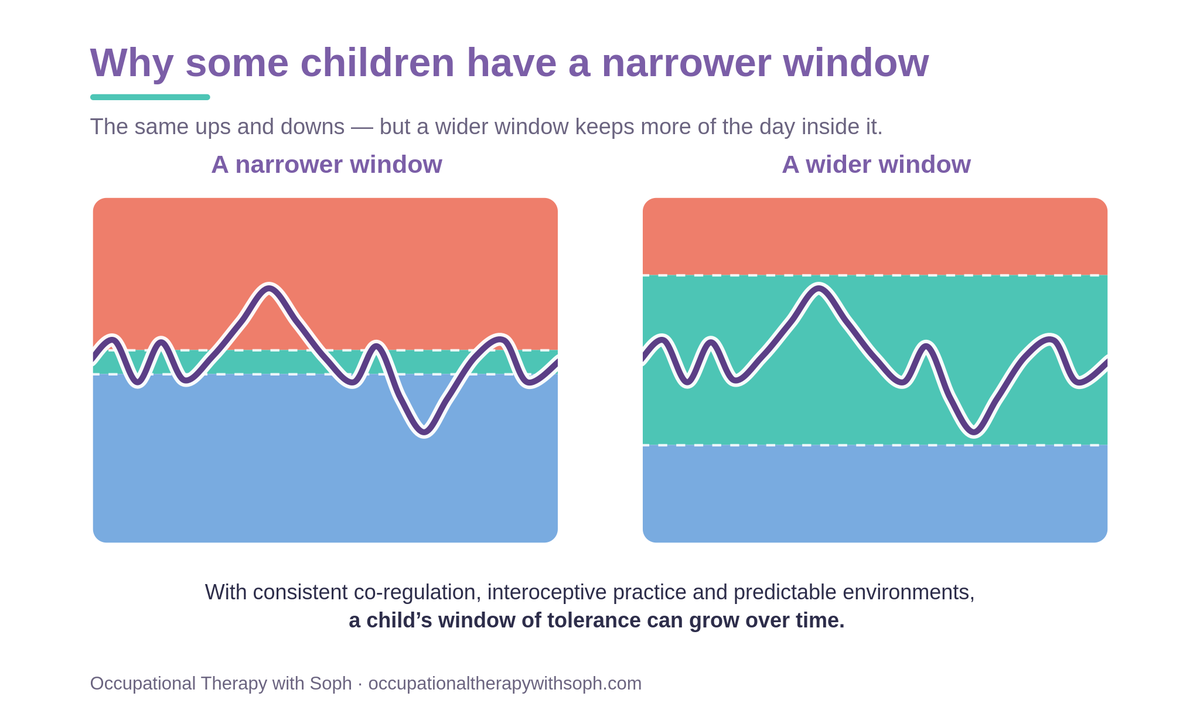
The same arousal pattern stays inside a wider window. With the right support, a child’s window of tolerance can grow over time.
What adults can do
The most important thing to understand is this: children cannot regulate their nervous systems alone. Co-regulation — the process of an adult’s calm, regulated nervous system helping to settle a child’s dysregulated one — always comes before self-regulation. Always.
Kim Barthel’s match-mirror-move framework is a useful guide here. First, meet the child where they are: acknowledge the state they’re in without trying to immediately fix or redirect it. Then gently mirror back a slightly calmer version of that energy. Then, slowly, invite movement toward regulation. This isn’t a quick fix. It’s a relational process, and it requires the adult to be regulated first.
Sensory input as a regulatory tool
One of the most direct ways to shift a child’s nervous system state is through the body itself.
Deep pressure and heavy work activities – things like carrying books, pushing a trolley, wall push-ups, crawling, or wearing a weighted lap pad — have a genuine calming effect on the nervous system.
Vestibular input — rhythmic, predictable movement like swinging, rocking, or bouncing — is similarly useful as a regulatory tool.
Rhythm in particular is thought to support nervous system regulation through its connections with autonomic pathways, which is why a dysregulated toddler often settles when walked and patted.
Predictability and reducing cognitive load
A nervous system that feels safe doesn’t need to stay on high alert. One of the most effective, and underrated, ways to widen a child’s window of tolerance over time is to reduce the amount of uncertainty their nervous system has to manage. Consistent routines, clear transitions, visual schedules, and advance warning before changes all lower the baseline demand on the nervous system.
Building interoceptive awareness
Alongside co-regulation, building interoceptive awareness over time can be helpful. Simple, regular body check-ins — “What does your heart feel like right now? Are your muscles tight or loose?” — help children start to notice and name their internal body signals before those signals become overwhelming. This works best as a daily practice in calm moments, not as a crisis strategy.
The foundations that are easy to overlook
Sleep, nutrition, and physical activity are not separate from nervous system regulation – they are foundational to it. A child who is chronically sleep-deprived, under-nourished, or largely sedentary will have a narrower window almost by default, because their nervous system is already under strain before the school day begins.
Play and connection
Finally, don’t underestimate play. Genuine, child-led, low-demand play — particularly with a safe adult — is one of the most effective nervous system regulators available to us. It activates the social engagement system, builds felt safety, and creates the kind of positive co-regulatory experiences that, repeated over time, literally reshape the nervous system’s capacity.
Building capacity, not fixing behaviour
The window of tolerance is not a fixed thing. With consistent co-regulation, interoceptive practice, and environments that reduce unnecessary stress, children’s windows can grow. That’s not a quick process – it happens over months and years, not days. But it does happen.
And it’s worth remembering what we’re actually aiming for. The goal is never to eliminate big feelings or engineer perfect behaviour — regulated doesn’t mean calm. It means having enough room, and enough support, to feel something big and move through it without tipping into crisis.
If you’re looking for a practical place to start, my free guide, 10 Tips to Build Interoception Skills & Emotional Regulation, covers body awareness strategies you can use straight away with the children you support.
For OTs and educators wanting a more structured toolkit, the Interoception Growing Bundle brings together everything I use in practice, from body signal visuals to activity cards and social skills stories, in one place.
Questions
If you have any questions or need further assistance please do not hesitate to get in touch here or at hello@otwithsoph.com.


